
Starting out with SharePoint

This week I’ve started implementing the SharePoint pilot at the office. Right now, the goal is to use it an “upgrade” to our current Intranet and provide some calendar and meeting workspaces for better collaboration.

Our existing Intranet is organized by department, with a subset of users in each department being responsible for updating content in their areas. Right now, we use the combination of a basic IIS website and Macromedia’s Contribute as the client application for updating the pages. We’d had some difficulty with the Contribute application and training, which has resulted in the Intranet being mostly static content.

For this implementation, I’ve set up one site collection with the main site being the company Intranet home page. Then I created additional sites for each department and a couple extra sites for some specialty areas, like our company-wide disaster preparation. Each of these sites will likely have different contributors, so I wanted to allow for different permission sets for each site.

I’ve spent some time populating each site with some of the content that exists on our current Intranet site, playing around with web parts and getting a feel for what I’d be able to implement in this first phase. I’ve spent several days just copying and pasting – it’s almost a little addictive. Our current Intranet has a lot of documents and forms for reference, so I still need to set up the necessary libraries and port that information over to mirror the current web experience in SharePoint.

I’d like to be able to hand over the majority of the content management to the contributors in each department once everything is officially “live” and we’ve organized some formal training. With the addition of web parts for announcements, discussion boards and wikis, I’m hoping SharePoint will allow our Intranet to become a more fluid destination with fresh information posted by a variety of staff members. I know I’m looking forward to using Wikis to provide more tips from the Helpdesk related to using ImageRight, Shoretel, email and our remote access solutions.
Windows Update Hiccups Occasionally

Ran into an interesting Windows Update issue today. I have a freshly built Windows 2008 Server and have it set to automatically run Windows Update. The majority of the updates were installing with incident, but it kept reporting a problem installing two updates – KB967723 (TCP/IP vulnerability) and KB976098 (time zone update).

The error code was 80070490, which isn’t particularly helpful. Most mentions of it I’ve run across in the ‘net involve Vista users who seem to think they need to reinstall their OS. Also not helpful and hopefully not the same problem!

Windows Update was happily installing other updates after the failed attempts, so the problem was specific to those two updates. The event log reported 4374 Warning – “package is not applicable for this system.” Seems that for some reason the Windows Update service was calling the wrong version of the package, as both of those updates apply to all the current Windows operating systems. Downloading each package and manually installing them did the trick.

Data Privacy Day: 1/28/10

Next Thursday, January 28th, is Data Privacy Day. It’s a relatively new day of celebration – this is the third year, but the goal is to promote awareness around data privacy and stimulate new development of privacy tools and encourage compliance with privacy regulations. Several events are being held in conjunction around the US, Canada and over two dozen European countries.
As an official sponsor, Microsoft will be participating in a event held in Washington, DC. Here in the bay area, Stanford Law School will be hosting an panel on Money and Privacy that is open to the community. Also, if you are so inclined, the International Association of Privacy Professionals will be having some “Privacy After Hours” evening networking events.
If nothing else, you might want to take some time that day to review some of the publicly available information about yourself. Type your name into your favorite search engine. Double-check those privacy settings in Facebook and make sure only a limited amount of information available is to people who aren’t part of your immediate network. Consider removing your profile from social networking sites you no longer participate in regularly.
The Internet and the growth of social media has made it so much easier to stay in touch with those we care about and connect with others who share our interests. However, don’t make it too easy for others to use those tools to against you.
And one more thing – it’s probably time you changed your password.

ImageRight and a Remote Desktop display bug

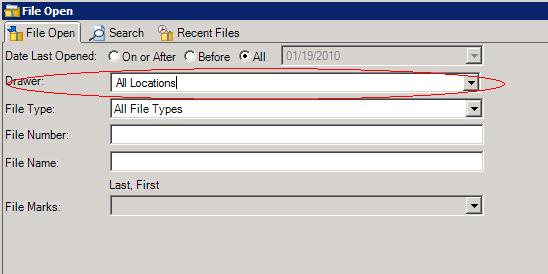
This week starts our official “pilot” roll out of Server 2008 RemoteApp. This is our planned replacement of Citrix for remote access to several of our regularly used applications. We are only using the Server 2008 (not R2) on the application server because our imaging application, ImageRight (version 4.3), does not support 64-bit. If you are planning on doing something similar, there is a minor display bug when access ImageRight v4 through the Remote Web Applications interface and it’s likely related to how the drop down menus are rendered using ActiveX. The problem is not repeated when one logs onto the server directly.


In the “File Open” menu, there are drop-down menus for choosing the drawer
and file type of the file you are looking for. In this example, the drawer selection defaults to “All Locations,” but depending on your personal settings, it may default to a particular drawer that is used most often.

When a user attempts to drop-down the drawer menu to select another option, the menu appears to snap closed quickly and does not allow a selection, making it impossible to switch drawers. (The File Type selection menu works fine.)

This display bug is not scheduled to be fixed in ImageRight version 4 of the software and it’s not a problem in version 5.0 according to ImageRight support. Meanwhile, the work-around is simple. Right next to the “File Open” tab, is a “Search” tab. The Search tab allows for more specific options to selected – down to page types and document descriptions. However, it all does the same basic features as the “File Open” tab.

In my office this isn’t a commonly used tab, we have another search tool that searches across other records databases at the same time, so I have to make sure to point out the issue to new users and provide the work-around information up front. While I’d like our remote access to ImageRight to be a seamless as working in the office, this display issue isn’t a showstopper.

Upcoming TechNet Event – Happening Near You!

The TechNet Events team is hitting the road again, bringing you presentations on Windows Azure, Hyper-V and demonstrations on simplifying Windows 7 deployments.

TechNet Events are free and with over 35 dates in cities across the United States, there’s bound to be one near you. The San Francisco session will be held on March 2nd. Registration is open now.

Certification Discounts

There are a few Microsoft and Prometric exam discount programs going on right now. If you have plans for working on a certification in the upcoming months, these deals might help you along.

  • Microsoft Second Shot – good for exams taken by June 30, 2010. You have to take the first attempt of the exam (and the 2nd attempt if needed) by the deadline.
  • Prometric 15% Off – schedule your exam by the end of February and take it by April 30, 2010.

These offers can’t be combined, but if you’ve got a few exams in the pipeline you might be able to take advantage of both.

Two Links from my last 24 Hours

It’s been a busy last few days, but I don’t want to forget a couple of links that have been useful recently.

The first comes from @nelz9999, who shared a link about managing geeks in the corporate environment. The second was happened upon by a co-worker as we were troubleshooting a BlackBerry trackball that wasn’t working properly. This is how you get those little things clean, but be careful when dealing with those tiny magnetic rollers.

Download the Employee Separation Checklist

I heard from quite a few people about how useful my post was about Employee Separations. As a bonus, I put together a document that breaks out the items into a checklist that you can edit to meet the needs of your environment. No matter how often you are removing user accounts or performing some other similar task, a checklist helps ensure you don’t miss anything in case your work is questioned at a later time.

New Hires – My System Admin Wish List

Last week I wrote about employee separations and the list of things that often need to be considered when an employee leaves. To balance that, here is the list of information I’d like to have handy when a new employee needs access to corporate resources.

  • Proper spelling of the person’s name (and if they have a preferred nickname) – Your company might insist that user accounts and email addresses be based on legal names, but if “Robert” always goes by “Bob” he may prefer “bjones” over “rjones” for his username. If your email global address book is sorted by first names, other staffers might look for Bob first under B, instead of R.
  • Start Date – I want to make sure everything is ready on the proper day. But, it’s also important to let me know if the start date is change or delayed. Most accounts are created with a generic, easy password and I would prefer to not have an active account hanging out there for an extra 2 weeks before the new hire can select a more secure password.

After the name and the start date, everything else tends to drift quickly from the ideal “standard” setup and slips to every employee being just a little bit different. By default, I give every new employee a personal home directory on the file server, access to their departments file share and membership on their department distribution list and any generic office lists, like “All Staff” or “San Francisco Office”.

  • Specialty Distribution Lists – Which other DLs do they need to be on? Contractors and employees might use different DLs. Managers, supervisors, special project lists, etc.
  • Phone Number – Will any available phone number do? Sometimes a hire is destined to replace someone who needs immediate coverage. If that’s not the case, I like to give out a fresh DID or at least one that hasn’t been used in a while. No one likes to spend their first weeks on the job fielding calls that don’t pertain to them. If I’m reusing numbers, I like to keep recycled numbers in the same department if possible. This way the new person in accounting won’t be getting calls directed to the person who retired from HR. And what about calling privileges – local only, long distance, international calling? How about membership in special hunt groups, dial-by-name directory? Do they need call appearances to pick up calls for manager or executive?
  • Applications and Security Groups – Which applications will they be using their first week or so? I know roles evolve and users always need their access adjusted. New hires usually will be learning 2-4 new applications immediately, so concentrate on finding out what those are. I don’t like to “make Bob the same as Joe”, because I know that Joe probably has membership in some security groups that Bob will never need. If the hiring manager can’t give you a list of which applications and data the new hire needs, remind them that security groups and application access are areas that are often looked at closely by auditors.
  • Hardware – What’s standard for others in that department or role? If you have options for different mice or keyboards, let the newcomer know so they can request changes sooner than later. Make sure they are connected to the closest printer to their workspace, etc.
  • Helpdesk Communications – Make sure they know the appropriate ways to submit help desk tickets or report problems. Should they use a ticketing-system? Send email? Call a special number? Pop into you cube? It’s a safe bet that people new to the office don’t want to annoy the IT folks, so set them up for success.
  • Training Documentation – Many departments have manuals or documentation about how various tasks are performed, IT is no different. Voice Mail instructions, conference bridge information, document management system procedures, “how-to” information for common FAQs related to Outlook or other applications… make sure the new hire knows how and where to find those things. It’s much easier help someone do something right the first time than to bother your DBA with bulk corrections to database information that was improperly entered.

Finally, document, document, document! File any forms or emails related to access needs and who authorized the access. Note the date you added or changed access going forward. Not only will this help with any audit needs, proper documentation can make it easier to remove access completely when someone leaves the company in the future.

Confessions of a new MVP

I confess. I’ve been a Microsoft MVP for less than 2 weeks and I didn’t realize what I was getting into. There is a well-known quote from “The Matrix” where Cypher says to Neo, “I know what you’re thinking, ’cause right now I’m thinking the same thing. Actually, I’ve been thinking it ever since I got here: Why oh why didn’t I take the BLUE pill?

I thought I had a pretty good handle on what resources I had available to me as an IT professional. TechNet, conferences, white papers, sponsored webcasts, blogs, books, user groups, training classes… My schedule was easy to fill.

And then comes the MVP award. Sure, I could just hang my certificate in my cube and call it a day. After all, it’s an award for recognizing past contributions to the tech community. But turns out its more than just an award. It’s a door to a world of resources and information that I didn’t know existed.

Barely a week has passed and I find myself trying to be realistic about the amount of information I can actually consume in the next year. There are more webcasts and chats and online meetings and downloadable resources than I can even begin to get my head around. I feel like a kid in a candy store, or perhaps like someone in the TV aisle of Best Buy, trying to figure out where to focus my attention first.

I’m sure I’ll have a better handle on what direction I should be facing as I get more comfortable with the ins and outs of the program. I’m looking forward to being able to use this experience as a way to give back to all those who’ve helped me out of a jam with a timely blog post or magazine article. But until then it seems like I’m back at my first days as a high school freshman. Does anyone know the way to the cafeteria?